
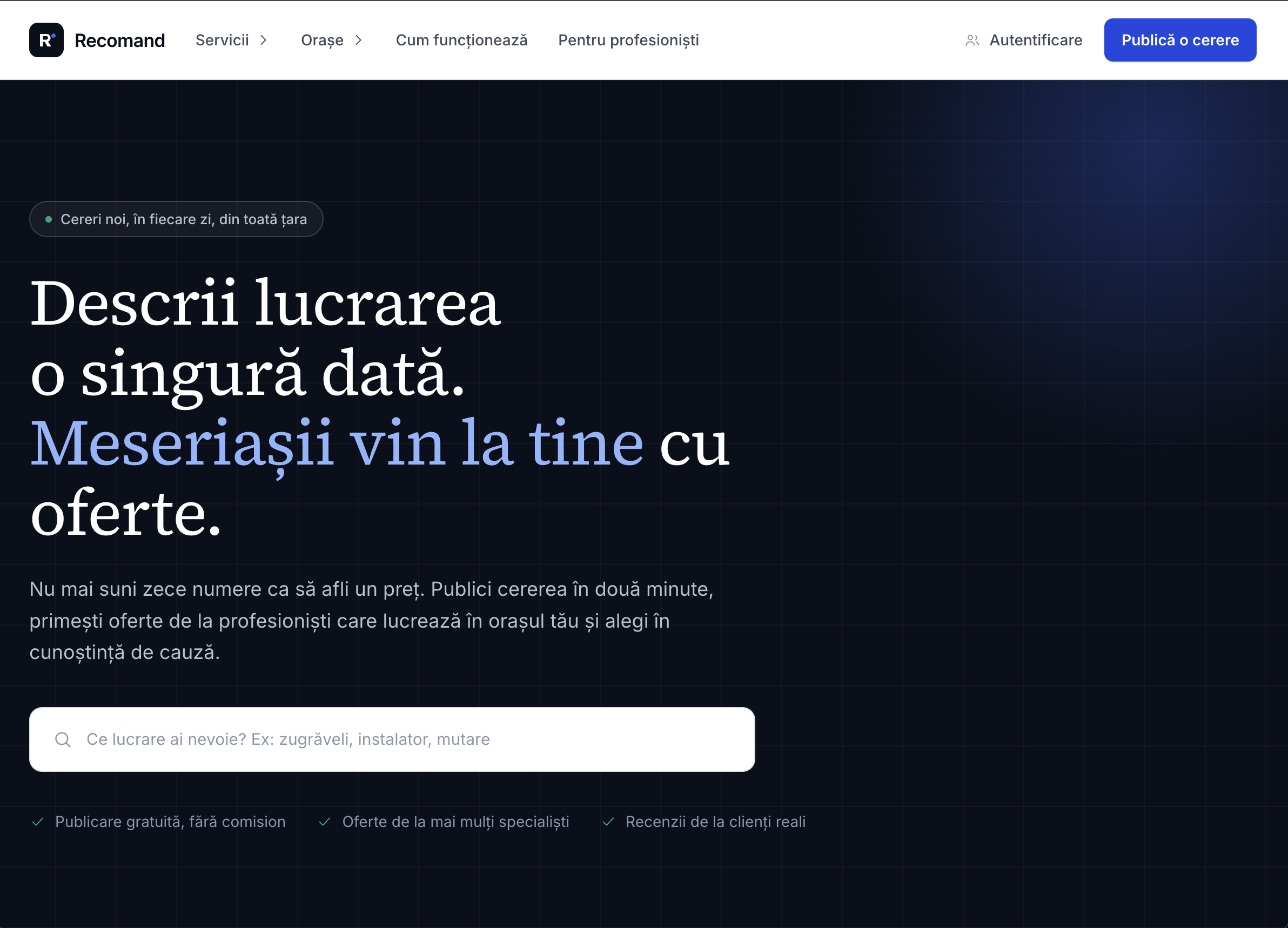
Recomand.app: looking for a tradesperson in your city? Describe the job once, get offers
About three years ago I needed a tradesperson. An ordinary job, nothing exotic. I opened my contact list and started calling.
By the seventh call I realised I had told exactly the same story seven times: what needed doing, where, roughly when, roughly what budget. Seven people, seven repetitions of the same description, three “I’ll call you back” that never came, and a single concrete price — with nothing to compare it against.
The problem wasn’t that there were no tradespeople. There were. The problem was that the effort of describing the job fell entirely on me, and it multiplied with every supplier I wanted to ask.
That’s how Recomand began.
The idea: describe it once, the offers come to you
The whole platform rests on a single inversion of the flow.
Instead of you hunting for tradespeople and repeating the story to each one, you describe the job once, and the request reaches the professionals who actually work in your area, on your service. They come to you with prices and timelines.
Three steps, from the client’s side:
- Describe the job — pick the service, say what you need, where and roughly when. It takes under two minutes and you don’t need an account beforehand.
- Receive offers — the request reaches professionals in your area, who send a price, a timeline and details.
- Compare and choose — see the offers side by side, with reviews from previous clients, discuss the details and choose.
The subtle but important difference: because every offer starts from the same description, they are comparable. You’re not comparing apples to oranges, because every tradesperson read exactly the same text.
What Recomand is today
It isn’t a concept on paper. It’s a working platform:
- 217 distinct services, grouped into 9 categories — from renovations and interior work (the largest category, 92 services) and installations, fitting and repairs (63 services), through to cleaning, moving and transport, health and personal care, business services, lessons and tutoring, events and legal.
- Coverage across 41 counties and more than 13,000 localities in Romania.
- Moderation on every request before it reaches professionals — the filter that keeps spam and incomplete requests away from tradespeople.
- Validated accounts for professionals: nobody sends an offer before passing the validation process.
- Real reviews, tied to real jobs on the platform, which stay attached to the profile.
- Your phone number visible only to the professionals who bid — it doesn’t turn into a contact list to be resold.
- Two mobile apps, with real-time notifications:
- 🔗 Recomand (clients) — Google Play
- 🔗 Recomand Pro (professionals) — Google Play · App Store
For clients, posting is free and there is no commission on the value of the job. You are under no obligation to accept any offer.
For professionals, the model runs on credits: you pay only for the requests you choose to open. No mandatory subscription, no commission on the job. You pick the services and the localities you work in, and you only receive requests that match. You see the request summary — description, deadline, locality — before you spend a credit.
I cared a great deal about this. A good tradesperson shouldn’t pay a monthly subscription for the privilege of receiving nothing in the slow months, and shouldn’t hand over a percentage of a job he carried out himself, with his own hands. He pays for access to the information, that’s all.
The part nobody usually writes: I abandoned it
I built the product. And then I let it sit.
Not because it didn’t work. Because I knew how to build the product, but I didn’t know how to promote it.
A marketplace has a problem an ordinary product doesn’t: it’s empty until you fill it from both sides at once. Clients don’t come if there are no tradespeople to answer. Tradespeople don’t stay if there are no requests. You can have the best technical execution on the market — if you don’t solve the cold start, you have a beautiful, empty database.
At that point I didn’t have the answer. I preferred to admit it rather than burn budgets on badly made ads, and I put the project on hold.
In hindsight, it was the right call. The mistake wasn’t the pause. The mistake would have been insisting with know-how I didn’t have.
What changed in the meantime
The years that passed weren’t a pause, they were school.
I worked on distribution, on automation, on programmatic SEO, on AI integrations, and on products taken from zero to real users. Among other things, I learned:
- that content at scale is the natural weapon of a marketplace with 217 services × 13,000 localities — every service-city combination is a real search intent, and the platform’s structure already supports it;
- that the hard part isn’t traffic, it’s liquidity: the ratio between requests and active tradespeople, for each service-area pair. It’s solved geographically, city by city, not nationally all at once;
- that acquiring professionals is a sales operation, not a marketing one, and it works differently from acquiring clients;
- that automation and AI make possible, for one person today, a volume of execution that three years ago would have taken me a team.
In short: the product was ready before I was. That’s no longer the case.
From here on
Recomand.app is live, with the client app on Google Play and the tradesperson app, Recomand Pro, on Google Play and the App Store. The growth part comes next — and unlike three years ago, this time I know exactly what to do.
If you have a job that needs doing: describe it once, at recomand.app/cerere. It’s free, it takes under two minutes and you’re not obliged to accept anything. If you’d like the details first, they’re here: how it works and frequently asked questions.
If you’re a tradesperson or run a services company: become a partner. The account is free, you pay only for the requests you open, and the reviews stay yours.
And if you’re the one sitting on a good project you put on hold because you didn’t know how to get it to people — it isn’t dead. It’s just waiting for the version of you that knows.


Frequently asked questions
Do you offer consulting or personalized services?
No. My philosophy is to build assets, not sell hours. I dedicate my time exclusively to developing products and automated systems. I believe that real long-term value lies in creating scalable solutions, not in offering 1-on-1 services.
Do you work alone on projects?
No. Most projects are developed together with a small team of collaborators. In recent years, I've consistently worked with 1-7 people, depending on the project. My main role is defining strategy, technical architecture, and product direction.
Can I collaborate with you on a project? If so, how?
I'm always looking for exceptional partners, not just collaborators. I look for people who bring top-tier competence and total alignment with the vision. Strategic partnerships are structured on performance and long-term commitment.
How can I get in touch with you to discuss?
The most efficient way is through the contact page. I prioritize strategic conversations and well-articulated proposals. I don't have time for superficial discussions, but I always respond with interest to messages that demonstrate substance and real potential.
How can I support your projects?
The most valuable support is strategic. An introduction to a relevant partner, pertinent feedback based on deep expertise, or a market opportunity I haven't seen are much more valuable than anything else.