I had some GPUs sitting idle. We’re currently organizing the data for an internal model — slow, careful curation work that doesn’t keep the hardware busy. So I thought: in the meantime, let’s run a test.
Not a serious model. An experiment. I wanted to answer a question I’d been asking myself for a while:
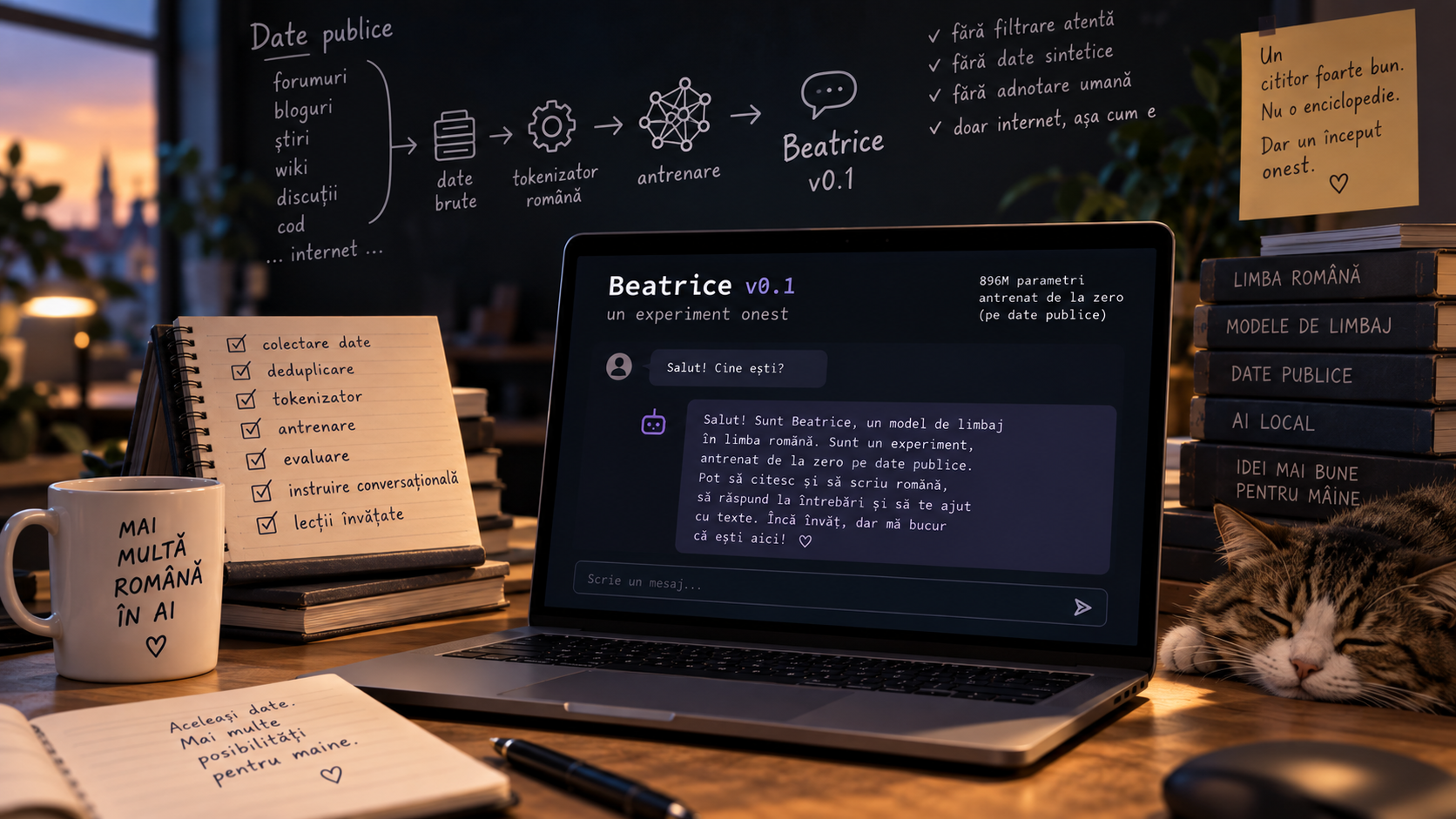
What comes out if you train a Romanian language model from scratch, using only public data, collected from the internet exactly as it is — no careful filtering, no curation, no synthetic data, no human annotation?
The result is called Beatrice v0.1. You can test it right now.
What it actually is
A model with 896 million parameters, trained from scratch, almost entirely in Romanian (the rest being a bit of English and code, for reasoning structure).
And to be clear from the start: Beatrice doesn’t claim to be intelligent. It’s not a production model, it competes with nothing. It’s a test of our training process — the pipeline from raw data to a model that speaks. I wanted to see it work end to end before we invest in the real model.
I built the whole chain: filtering, deduplication, a tokenizer trained from scratch on Romanian (twice as efficient as GPT-2’s on Romanian text), the data mix, the training, the conversational fine-tuning. Every piece worked. That was the real goal.
What I learned, and it’s the interesting part
I evaluated the model on over a thousand questions. What emerged is a profile that says everything about what a model this size is:
- It writes correct, natural Romanian. Grammar, diacritics, natural word order, idiomatic expressions. This is where the filtered corpus proved its worth.
- It excels at reading comprehension. Give it a context and a question about it, and it extracts the right answer. In my tests: 100%.
- It makes up facts. Asked “from memory” about populations, years, names — it confidently answers false things. On general-knowledge quizzes it scores at chance.
In other words: a very good reader, not an encyclopedia.
And that’s not a bug to fix — it is the profile of an 896M-parameter model. It has nowhere to store knowledge about the world. What it can do, and does well, is read a text and rephrase it in clean Romanian. Hence the practical takeaway: a small model like this works best coupled with a source of information — you give it the text, it does the wording. Left on its own, it hallucinates.
It’s a lesson I knew in theory. Now I have it measured, in Romanian.
Honesty matters more than hype
I could have written “I trained a Romanian LLM” and stopped there. But Beatrice has real limits, and I’m stating all of them: it invents things, it doesn’t admit when it doesn’t know, it has no safety filters. I wrote them into the model card too, in plain text.
Not out of modesty. Because a model presented as more than it is ages badly — people discover its limits anyway, on their own. Better to know them from the start and focus on what it actually does well.
And what Beatrice does well — read and write Romanian — is no small thing for an experiment that came out of GPUs that would otherwise have sat idle.
What’s next
Beatrice v0.1 is step zero. In 1–2 months we’ll train the real model, on filtered, quality data — synthetic plus human-written, not raw public text. It’ll be more coherent, less prone to hallucination, and probably easier to run.
The difference between the two won’t be the model’s size. It’ll be data quality. Beatrice is the proof, by counterexample: raw data → a competent reader that confabulates. I want to see how much the bar rises when the data is carefully organized.
Test it yourself
The model is public. Anyone curious can try it:
🔗 huggingface.co/krakiun/ro-nanochat-d20-chat
It runs locally, with a single command — the instructions are on the model page. No account, no cloud, nothing leaves your computer.
Say “hi,” ask it a question, give it a text and ask it to answer based on it. You’ll quickly see both what it can do and where it stumbles. Both are interesting.
Feedback and criticism welcome. Beatrice wasn’t built to impress — it was built to learn from. And honest criticism is part of that.
 By
By